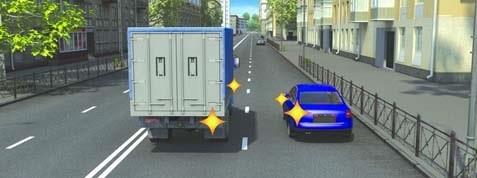
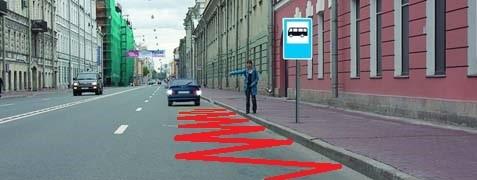
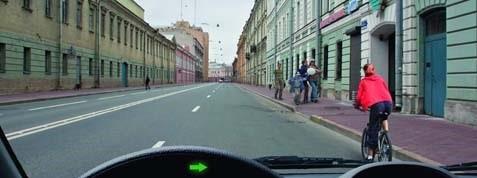
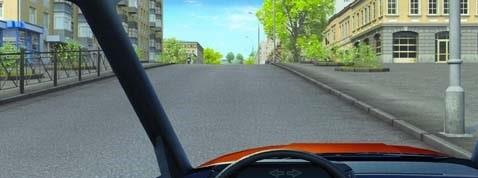
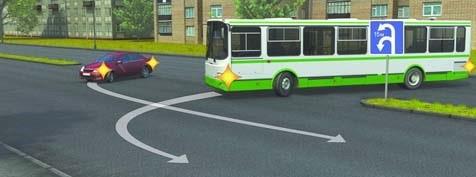
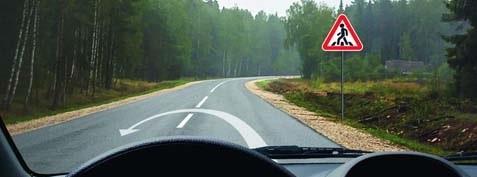
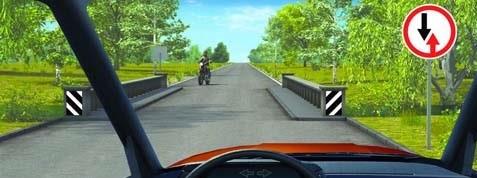
Group 1 · Question 126.
1. Truck2. Passenger car
Reveal correct answer Group 1 · Question 127.
1. Yes2. No
Reveal correct answer Group 1 · Question 128.
1. Pedestrians only2. Cyclist only3. None4. Cyclist and Pedestrians
Reveal correct answer Group 1 · Question 129.
1. It can be done in one go2. 100 meters visibility is ensured from both sides3. Prohibited.
Reveal correct answer Group 1 · Question 130.
1. Bus driver2. Passenger car
Reveal correct answer Group 1 · Question 131.
1. Allowed in conditions of 100 m visibility from both sides2. Prohibited.
Reveal correct answer Group 1 · Question 132.
1. Yes2. No
Reveal correct answer Group 2 · Question 1.
1. A person, other than the driver and the driver-in-training, who is in the passenger compartment (cabin) of the vehicle (on it).2. A person, other than the driver and the driver-in-training, who is inside (on) the vehicle (cabin), as well as a person who enters (sits on) or leaves (gets off) the vehicle.
Reveal correct answer Group 2 · Question 2.
1. 16 years of age.2. 17 years of age.3. 18 years of age.
Reveal correct answer Group 2 · Question 3.
1. 17 years of age.2. 18 years of age.3. 19 years of age.
Reveal correct answer Group 2 · Question 4.
1. A road element designed for vehicular traffic.2. A road element designed for the movement of non-rail vehicles.
Reveal correct answer Group 2 · Question 5.
1. Required.2. Not required.3. Required if it makes it difficult to drive a car.4. Not required if the instructor allows to drive.
Reveal correct answer Group 2 · Question 6.
1. 18 year-old persons2. 19 year-old persons3. 20 year-old persons4. 21 year-old persons
Reveal correct answer Group 2 · Question 7.
1. A person on the road, outside the vehicle, except for a person authorized to carry out road works and to carry out such works in the manner prescribed by law.2. A person on the road, outside the vehicle, including a person authorized to carry out road works and carrying out such works in the manner prescribed by law.
Reveal correct answer Group 2 · Question 8.
1. On roads outside populated areas, taking into account the intensity of vehicular traffic.2. On closed sites or autodromes.3. On any road (except highways) taking into account the intensity of vehicle traffic.
Reveal correct answer Group 2 · Question 9.
1. Not considered.2. Considered.
Reveal correct answer Group 2 · Question 10.
1. 750 kg2. 800 kg3. 1000 kg
Reveal correct answer Group 2 · Question 11.
1. Persons of at least 16 years old.2. Persons over the age of 17.3. Persons of at least 18 years old.
Reveal correct answer Group 2 · Question 12.
1. A two- or three-wheeled vehicle with an engine with a displacement of not more than 50 cub.cm. and a maximum speed of not more than 50 km/hour.2. A two- or three-wheeled vehicle, with an engine with a displacement not exceeding 60 cub.cm. and a maximum speed not exceeding 60 km/hour.3. 3. Two or three-wheeled vehicle, with an engine with a displacement not exceeding 70 cub.cm. and a maximum speed not exceeding-. 70 km/hour.
Reveal correct answer Group 2 · Question 13.
1. Traffic interruption due to unexpected switching of a traffic light signal.2. Interruption of traffic due to traffic jams.3. Due to the malfunction of the vehicle, the physical (and) mental condition of the driver (passenger) and (or) the transport of the cargo due to danger or other obstacle on the road.4. In all the cases above.
Reveal correct answer Group 2 · Question 14.
1. The visibility distance of the road during the dark time of the day.2. The visibility distance of the road in the settlements in the absence of artificial lighting of the roadway.3. For fog, rain, snow and (or) road safety in other adverse weather conditions, road visibility and (or) visibility of the distance up to 300 meters.
Reveal correct answer Group 2 · Question 15.
1. Up to 5 minutes or bringing the vehicle to a deliberate immobile position for the time necessary for the passenger to sit, get off and (or) load and unload the vehicle.2. Immobilizing the vehicle for more than 5 minutes, if it is not related to the seating, lowering or loading or unloading of the vehicle.
Reveal correct answer Group 2 · Question 16.
1. A vehicle with stopping points (stops), moving on routes, transporting passengers and (or) luggage (tram, trolleybus, bus).2. Vehicles (trams, trolleybuses, buses), as well as taxis, which have stopping points (stops), move on routes, transport passengers and (or) luggage.
Reveal correct answer Group 2 · Question 17.
1. Persons with disabilities who move around in wheelchairs without a motor.2. Persons driving (pushing) a cart, sled, baby or wheelchair.3. All of the above persons.
Reveal correct answer Group 2 · Question 18.
1. Any mechanical vehicle that is towed by a rigid coupling.2. 2. Any vehicle not equipped with an engine which is intended to be driven as a single unit in conjunction with a motor vehicle (including special attachment).
Reveal correct answer